I love the irony involved in a sensitive species with a name that starts with "common." But the common loon isn't endangered, thankfully. It's still somewhat common. In fact I've often seen them at the Nisqually Wildlife Refuge.
The state of Washington lists sensitive, threatened, and endangered species. Here are the animals on the first of those three lists.
FISH:
Olympic Mudminnow
Pygmy Whitefish
Margined Sculpin
AMPHIBIAN:
Larch Mountain Salamander
BIRDS:
Common Loon
Peregrine Falcon
American Peregrine Falcon
Arctic Peregrine Falcon
Peale's Peregrine Falcon
MAMMALS:
Gray Whale
The scientific names for these species are listed on the Dept. of Fish and Wildlife page: http://wdfw.wa.gov/wlm/diversty/soc/endanger.htm?sort_a=AnimalType&StateStatus=SE&StateStatus!=none
Thursday, December 7, 2006

Tuesday, December 5, 2006
Counties with the most cities and towns
It's no surprise that most of the cities and towns are in the Puget Sound area. That is, of course, where the population is centered. But the three top counties on this list are followed immediately by five eastern Washington counties. The (usually) smaller rural towns organized themselves much earlier than their counterparts in the west -- many of which incorporated and started emerging from suburban sprawl only in the last fifteen years.
By the way-- there are many "towns" in Washington, but many are simply settlements or large adjacent neighborhoods. The numbers listed below include only those incorporated into organized formal local governments.
1. King County, 39
2. Pierce County, 24
3. Snohomish County, 20
4. Whitman County, 16
5. Grant County, 15
6. Yakima County, 14
7. Okanogan County, 13
7. Spokane County, 13
9. Grays Harbor County, 9
9. Lewis County, 9
By the way-- there are many "towns" in Washington, but many are simply settlements or large adjacent neighborhoods. The numbers listed below include only those incorporated into organized formal local governments.
1. King County, 39
2. Pierce County, 24
3. Snohomish County, 20
4. Whitman County, 16
5. Grant County, 15
6. Yakima County, 14
7. Okanogan County, 13
7. Spokane County, 13
9. Grays Harbor County, 9
9. Lewis County, 9
Sunday, December 3, 2006
Wettest months in Seattle history
By now, I'm sure you heard that it's official. All that rain last month in Seattle -- a city known nationally for being wet -- set a new record. And while November might have set a new standard, a gander at this list of the all-time wettest months in these parts might surprise you: another month from this year was already on the list.
1. 15.63 inches: November, 2006 RECENT
2. 15.33 inches: December, 1933*
3. 12.92 inches: January, 1953
4. 11.85 inches: December, 1979
5. 11.80 inches: December, 1897*
6. 11.65 inches: January, 2006
* Measured at Federal Building in downtown Seattle. All others were recorded at Sea-Tac Airport.
Data source: www.noaa.gov
1. 15.63 inches: November, 2006 RECENT
2. 15.33 inches: December, 1933*
3. 12.92 inches: January, 1953
4. 11.85 inches: December, 1979
5. 11.80 inches: December, 1897*
6. 11.65 inches: January, 2006
* Measured at Federal Building in downtown Seattle. All others were recorded at Sea-Tac Airport.
Data source: www.noaa.gov
Thursday, November 30, 2006
Washington's largest counties
A few counties in Washington are pretty big. Okanogan County, up along the Canadian border in central Washington, is the largest of all. It's larger than three different states. Several other counties outrank states, too. For comparison's sake as you glance at the list below, Rhode Island is America's smallest state at 1,545 square miles; Delaware is next at 1,954; and Connecticut is 4,845 square miles in area.
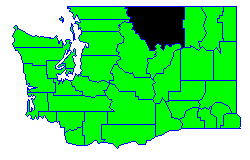 -1. Okanogan, 5,268 square miles
-2. Yakima, 4,296
-3. Chelan, 2,921
-4. Grant, 2,681
-5. Stevens, 2,478
-6. Lewis, 2,408
-7. Lincoln, 2,311
-8. Kittitas, 2,297
-9. Ferry, 2,204
10. Whitman, 2,159
Note: No, Okanogan isn't the largest county in the United States. I suppose a region in Alaska would qualify as the largest, but Alaska doesn't exactly have a comparable county concept. Among counties in the Lower 48, though, San Bernadino County, California is largest: 20, 105 square miles -- almost four times the size of Okanogan.
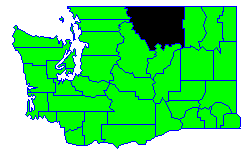 -1. Okanogan, 5,268 square miles
-2. Yakima, 4,296
-3. Chelan, 2,921
-4. Grant, 2,681
-5. Stevens, 2,478
-6. Lewis, 2,408
-7. Lincoln, 2,311
-8. Kittitas, 2,297
-9. Ferry, 2,204
10. Whitman, 2,159
Note: No, Okanogan isn't the largest county in the United States. I suppose a region in Alaska would qualify as the largest, but Alaska doesn't exactly have a comparable county concept. Among counties in the Lower 48, though, San Bernadino County, California is largest: 20, 105 square miles -- almost four times the size of Okanogan.
Wednesday, November 29, 2006
The Whitman Massacre Tragedy
In what historians believe was retaliation against whites for Indian deaths, Cayuse tribesmen attacked the Whitman Mission at Waiilatpu (near the modern town of Walla Walla) 159 years ago today -- November 29, 1847. Measles had ravaged the Indian population but seemed to spare the whites. Marcus Whitman and his wife Narcissa, who had established the mission eleven years earlier, were unable to treat the sick Cayuse. Two Indians, Tilaukait and Tamsuky, struck Dr Whitman with a tomahawk in the kitchen of the house. Then they chased down and killed most of the others at the mission, including Mrs Whitman and several children. Dozens of settlers lived at Waiilatpu. By the end of the day, fourteen people were dead. Most of the others were captured and held for ransom.
This was no small incident. The Whitman Mission was a major stop for settlers travelling west, and the Whitmans themselves were well known and respected. The violence of their murders sparked great concern among Anericans in the Northwest and in the nation's capital thousands of miles away. It was no coincidence that Congress quickly decided to arrange a greater presence in the region and created the Oregon Teritory the following August 13.
Killed at Waiilatpu:
- Marcus Whitman, 44
- Narcissa Whitman, 39
- Crocket Bewley, 18
- Isaac Gilliland, adult
- Peter Hall, adult
- Jacob Hoffman, adult
- Nathan Kimball, adult
- Walter Marsh, adult
- Andrew Rogers, adult
- John Sager, 17
- Francis Sager, 15
- Amos Sales, adult
- W L Saunders, adult
- James Young, 24
Dying during the subsequent captivity:
- Helen Mar Meek, 10
- Louise Sager, 6
Note: There are three Sager children on this list. The story of their family -- even before Wailatpu -- is heart-wrenching. I'm sure to talk about them again.
Tuesday, November 28, 2006
Most Influential Americans: the Washingtonian edition
The Atlantic Monthly released its December issue last week with a list of the 100 most influential figures in American history. It's a decent list, I'd say. Sure, there are a few people that I'd add, subtract, or shuffle. You probably would, too. These sorts of lists invite that kind of discussion. But I'll refrain from that here only because this blog likes to focus on Washington state. So, who on the Atlantic's list have Washington connections? Just a few:
- 4. Franklin D Roosevelt. He got the concrete pouring on the big dam projects of the Columbia River.
- 12. Ulysses S Grant. The future war hero and president served in the army stationed in Vancouver before the Civil War.
- 28. Dwight D Eisenhower. Another war hero and future president got his feet wet with the first command job of his military career, serving at Fort Lewis on the eve of World War II.
- 54. Bill Gates. The only native Washingtonian on the list.
- 70. Lewis and Clark. The first to traverse the continent on foot. They saw the Pacific Ocean from Washington soil.
I could have stretched further to add more names here, but most of the others I'd name either just visited (e.g., Mark Twain) or imagined (e.g., Thomas Jefferson) the Northwest.
Sunday, November 26, 2006
First ascents of Washington's volcanoes
Five volcanoes rise above the Cascade Range in Washington state and all are popular among mountaineers. In fact, all five were climbed before the end of the nineteenth century, when mountain climbing had not yet fully matured as a sport. William Fraser Tolmie, chief factor at Fort Nisqually, a British outpost near modern DuPont, made the first attempt to reach one of these peaks in the 1830s when he worked his way onto the lower slopes of Mt Rainier. But it would be more than a decade before the first Washington volcano was summited, and more than three decades before two men -- one the son of our first territorial governor -- finally stood atop Rainier.
- Mount St Helens (9,677 feet*): Dryer, Wilson, Smith, and Drew, 1853 Aug 27
- Mount Adams (12,276 feet): Aiken, Allen, and Burge, 1854 late summer
- Mount Baker (10,778 feet): Coleman, Tennant, Ogilvy, and Stratton, 1868 Aug 17
- Mount Rainier (14,111 feet): Hazard Stevens & Philemon B. Van Trump, 1870 Aug 17
- Glacier Peak (10,541 feet): Gerdine, Strom, Dubar, and Bard, 1897 early summer
*All elevations given here are thought to be accurate for the actual climbs. St Helens is 8,364 feet high since its 1980 eruption, but was 9,677 feet before that. The climbers of the other peaks either had incorrect or no elevation estimates at all.
Saturday, November 25, 2006
Washington ski areas
Several of the ski areas in Washington opened this week. The rain in the lowlands usually means snow in the mountains. And plenty of it, I hope. Current conditions and more information are available at www.skiwashington.com. Here are most of Washington's downhill ski areas, sorted north to south:
- Mount Baker (Whatcom County) on State Route 542
- Sitzmark (Okanogan County) southeast of Oroville
- Loup Loup (Okanogan County) east of Twisp
- 49 Degrees North (Stevens County) east of Chewelah
- Hurricane Ridge (Clallam County) south of Port Angeles
- Echo Valley (Chelan County) north northwest of Chelan
- Mount Spokane (Spokane County) northeast of Spokane
- Stevens Pass (King/Chelan Counties) on Highway 2
- Leavenworth (Chelan County) north of Leavenworth town
- The Summit at Snoqualmie (King/Kittitas Counties) at Snoqualmie Pass
- Squilchuck (Chelan County) south southwest of Wenatchee
- Mission Ridge (Chelan County) south southwest of Wenatchee
- Crystal Mountain (Pierce County) east of Mt Rainier
- White Pass (Lewis/Yakima counties) on Highway 12
- Ski Bluewood (Columbia County) south southeast of Dayton
Friday, November 24, 2006
An historic voting roll
The list of names below is historic in two ways: big and gigantic.
It was big because it's the voting roll for the first vote on land that would eventually become Washington State. On the evening of November 24, 1805, Captains Lewis and Clark polled the members of their expedition on the matter of where the winter camp should be. They decided to examine the south side of the Columbia River (eventually settling on Fort Clatsop near modern Astoria), but the actual vote was held on the north side of the river at 'Station Camp' near modern community of Megler, Washington.
It was gigantic because of the last two people on the list. York, a black slave, and Janey, better known to us as Sacagawea, were invited to vote with the other men of the expedition. Since the military expedition was officially sanctioned by the United States government and Lewis and Clark were the de facto executives on site, this vote was significant. The votes of York and Janey were the first official votes cast by an African American or a woman in American history.
And it happened on Washington soil 201 years ago today.
Sergt J. Ordway
Serjt. N. Pryor
Sgt. P. Gass
Jo. Shields
Go. Shannon
T. P. Howard
P. Wiser
J. Collins
Jo Fields
Al. Willard
R Willard
J. Potts
R. Frasure
Wm. Bratten
R. Fields
J: B: Thompson
J. Colter
H. Hall
Labeech
Peter Crusatte
J. B. Depage
Shabono
S. Guterich
W. Werner
Go: Gibson
Jos. Whitehouse
Geo Drewyer
McNeal
York
Janey
It was big because it's the voting roll for the first vote on land that would eventually become Washington State. On the evening of November 24, 1805, Captains Lewis and Clark polled the members of their expedition on the matter of where the winter camp should be. They decided to examine the south side of the Columbia River (eventually settling on Fort Clatsop near modern Astoria), but the actual vote was held on the north side of the river at 'Station Camp' near modern community of Megler, Washington.
It was gigantic because of the last two people on the list. York, a black slave, and Janey, better known to us as Sacagawea, were invited to vote with the other men of the expedition. Since the military expedition was officially sanctioned by the United States government and Lewis and Clark were the de facto executives on site, this vote was significant. The votes of York and Janey were the first official votes cast by an African American or a woman in American history.
And it happened on Washington soil 201 years ago today.
Sergt J. Ordway
Serjt. N. Pryor
Sgt. P. Gass
Jo. Shields
Go. Shannon
T. P. Howard
P. Wiser
J. Collins
Jo Fields
Al. Willard
R Willard
J. Potts
R. Frasure
Wm. Bratten
R. Fields
J: B: Thompson
J. Colter
H. Hall
Labeech
Peter Crusatte
J. B. Depage
Shabono
S. Guterich
W. Werner
Go: Gibson
Jos. Whitehouse
Geo Drewyer
McNeal
York
Janey
Thursday, November 23, 2006
Counties with two-word names
Here's one of those meaningless lists. Of the 39 counties in Washington, four require two words to identify them. Walla Walla, of course, using the same word twice. It's county seat, also Walla Walla, doubles even that, producing a remarkable "address": Walla Walla, Walla Walla, Washington.
- Grays Harbor
- Pend Oreille
- San Juan
- Walla Walla
Subscribe to:
Posts (Atom)